
IPPT Calculator Singapore (2026)
Use this new IPPT calculator to immediately calculate your Individual Physical Proficiency Test (IPPT) score based-on push-ups, sit-ups, and your 2.4km run timing. Insert your age, and performance outcomes to get your cumulative points and see if you qualify for Pass, Silver, or Gold. This IPPT score calculator is a game changer for you since it provides precise, easy to use, and fast scoring method. It’s always fruitful to plan your training before your test to achieve your desirable goals.
How to Use the IPPT Calculator (Video Guide)
The usage of IPPT calculator is as easy as pressing a button. It takes a few seconds to enter your credentials and performance results to directly view your cumulative IPPT score, admissibility status, and reward classification. The IPPT points calculator provides certified scoring structure followed by accurate and credible results.
Steps to Calculate Your IPPT Score

After following these steps, it will get you to your overall score, reward level, and rank points, and any other points needed you to get to the next round. This IPPT calculator is a handy tool for your daily use to track your improvement and modify your exercise plan.
What Is IPPT in Singapore?
Individual Physical Proficiency Test (IPPT)🔗 is a typical physical fitness test for Singapore Civil Defence Force (SCDF), Singapore Armed Forces (SAF) and Singapore Police Force (SPF) specified for Singapore citizens. This test involves push up, sit-up, and 2.4 km run and more than 100,000 citizens participates in this test yearly. Furthermore, people prefer to use IPPT calculator in Singapore for estimating their points which helps them to work on their physical weaknesses if they have any.

What Is the Individual Physical Proficiency Test (IPPT)?
The Individual Physical Proficiency Test (IPPT) is a compulsory fitness evaluation managed by the Singapore Armed Forces to assess the physical readiness of Singapore citizens intending to serve as National Servicemen.
The main criteria to measure the performance depends upon three modules: sit-ups, push-ups, and a planned 2.4km run. Scores are computed built on age and gender which directs towards achieving a Pass, Silver, or Gold reward.
For male applicants, the IPPT Male calculator could potentially be the tool to estimate scores precisely, while IPPT calculator female would be the first choice for female individuals. This IPPT structure certifies soldiers uphold their fitness ethics essentially needed for armed services.

The Birth of National Service (NS)
Singapore became independent in 1965 – a year when the nation encountered the extreme challenge of their army shortage. Two years later, they announced the National Service Act demanding all male citizens to fight for their country. National Service (NS) goes beyond a duty and becomes a significant experience that shapes people and those surrounding them. In addition, NS service people are recommended to use IPPT calculator NS for their performance measurement.
Registration and Fitness Preparation

Enrollment Day, Basic Military Training and NSman Life
Enrollment day begins with the Basic Military Training (BMT), where newcomers absorb warrior skills, perform physical and field drills. After training, they engage in exercises like yearly fitness and In-Camp Trainings (ICT) to keep their morale high. Finally, they conclude their NS duties whilst showing casing their qualification, discipline, and passion for the nation.
Pre-enlistee IPPT, PES & Training Overview
The NS process starts when individuals reach the age of 16½ with preliminary guidelines and the first appointment at CMPB. Candidates must pass through the necessary fitness assessments, medical scrutiny, and Physical Employment Standard (PES) procedure to establish their physical resilience. Students are allowed to reschedule admission in order to finish their studies.
Beginners in the Pre-Enlistee IPPT, who medically qualified and scored at least 61 points using IPPT calculator are categorized as A or B1. They are entitled to reduce their full-time NS by as much as 8-weeks. Make sure the IPPT is done at least 2-weeks before your PTP registration date, and the scores are acceptable for a year after the test. Students who have taken tailored NAPFA exam in schools like Junior College, ITE or, Polytechnics could take exemption from an individual Pre-Enlistee IPPT.
Pulau Tekong is the facility where the enlistment day begins with the Basic Military Training (BMT) which includes physical drilling, army discipline, arsenals supervision, and collaboration. Servicemen are supposed to serve for 2-years where they need to maintain their health, receive monthly compensations, and settle into military environment till their Operationally Ready Date (ORD), this is when their full-time service comes to an end. However, their deployment in the war depends on their education, medical rank, fitness outcomes and PES level.
Understanding the IPPT Scoring System
The IPPT (Individual Physical Proficiency Test) determines the physical capability of National Servicemen by 3-ways such as sit-ups, push-ups, and a 2.4 km run. Each step adds to an overall score out of 100, with scoring regulated as per age group. Contestants have to hit at least 1 point in each step in order to successfully pass the IPPT. This procedure urges servicemen to continue steady strength and develop their performance with the passage of time.
The modern IPPT arrangement allots 50 points to the 2.4 km run and 25 points both to sit-ups and push-ups. Quicker running times and higher repetitions increase the odds of reaching to higher stages, and the overall score decides the Pass, Silver, or Gold reward for a contender. This grading skeleton guarantees equality while tempting applicants to build strength.
IPPT Performance Standards & Group Variations
IPPT performance criteria depend on the contestant’s service class and age bracket. Freshers are expected to perform much higher than the senior ones. This confirms the transparency of the test and the compatibility of the national fitness principles.
Special applicant class follows marginally different assessment standards:
These targets offer a general understanding of the fitness points mandatory to attain different IPPT rewards.

IPPT Awards & Passing Criteria
IPPT results are sorted into accomplishment ranks depending on the total score cumulated. Higher points measured using IPPT calculator show tougher physical performance and make contestants eligible for rewards.
IPPT Reward & Incentive Table
Beginners who wants to serve in the Singapore National Army and highly motivated to finish at the top are suggested to review this key performance table to anticipate their IPPT score and reward.
| Achievement Level | Points | Possible Reward |
| Gold | 85+ | $500 |
| Silver | 75 | $300 |
| Pass with Incentive | 61 | $200 |
| Pass | 51 | No reward |
These rewards motivate interested servicemen to put their 100% and get maximum performance heights during their IPPT efforts.
IPPT Points Table (Sit-Ups, Push-Ups, 2.4km Run)
IPPT scores are measured by adding up three fitness levels in the IPPT calculator. Each set of exercise backs different number of points in the overall IPPT points calculator.
IPPT Points Distribution
Freshers who are looking to determine their fitness standards can follow the subsequent IPPT scoring table:
| Exercise | Task | Performance Factor |
| Push-Ups | 25 | More repetitions = Higher points |
| Sit-Ups | 25 | Higher repetitions increase IPPT score |
| 2.4 km Run | 50 | Faster run time earns more points |
The 2.4 km run influence the most among others in attaining the highest score, however, applicants who dominate in all three formats reaches to the top level and earn Silver or Gold reward.
How to Take the IPPT Test
Fitness Conditioning Centers (FCCs) is the elected place in Singapore where IPPT test is taken place, containing sub-campuses in Kranji Camp and Maju Camp. OneNS is the official declared portal by the authorities to have the aspirants book their test with ease. Runners are recommended to reserve the test well before time, so that they can have ample time for preparation and the date of their own desire. Moreover, every test continues for one and half hour which includes registration, break periods, and trainings.
Overview of Stations
The IPPT comprises of three physical capability levels dedicated to judge muscle, perseverance, and cardiac performance:
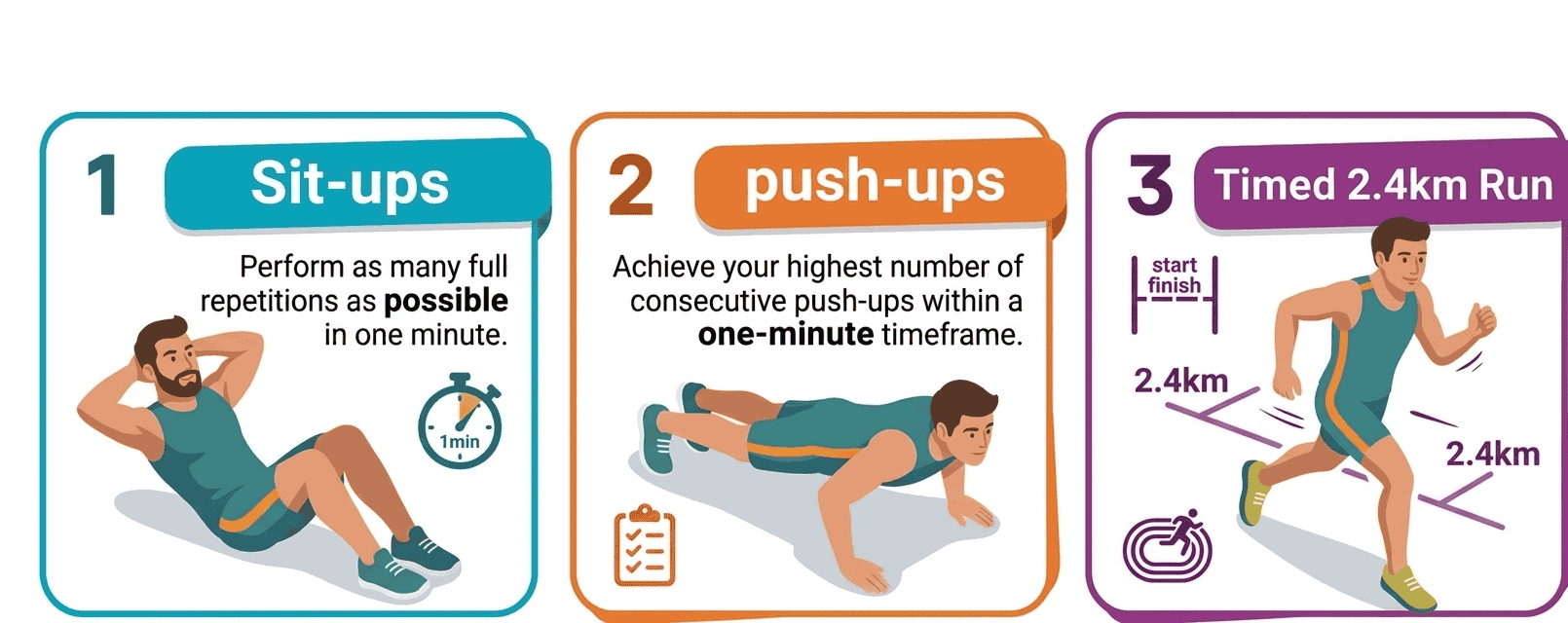
Test Flow
This test obeys a specific pattern to warrant impartiality and reliability. Following steps needs to be followed for this:

Timing Rules
All IPPT levels has their own requirements such as:
| Station | Time Limit | Purpose |
| Push-Ups | 1 minute | Measures upper body muscular endurance |
| Sit-Ups | 1 minute | Tests stomach and core strength |
| 2.4 km Run | Timed run | Evaluates cardiovascular persistence |
Contenders are supposed to earn at least 1 point at each station, and overall passing score is 61 out of 100. Early preparations and absorbing the exact test layout will considerably enhance the players performance.
How to Improve Your IPPT Score
Feeling stuck with your IPPT score? Note sure how to improve IPPT score? This article has all you need to be different among thousands. Below are pro tips to develop your IPPT results.
Top Tips to Improve Your IPPT Score

Preparing for Sit-Ups

Preparing for Push-Ups

Preparing for the 2.4 km Run

What Happens If You Fail IPPT?
You need to follow these steps if things do not go in your favor:
Booking Your IPPT Session in Singapore
Are you looking to book your seat early? If Yes! It can be booked as early as 3-months in advance through the official OneNS portal, since special seats gets booked speedily.
How to Book Your IPPT Test

Changing or Cancelling Your Booking
The session can be rebooked using portal If something comes up, and you are unable to attend the session.
If an IPPT Session Gets Cancelled
Sometimes booked slots can get cancelled because of climate or other reasons, if this happens, you are advised to contact your unit’s S8 or National Service Relations Officer for alternative options.
Why Use an IPPT Calculator?
An enhanced IPPT calculator is a powerful tool used to measure your points or score by taking into account your performance at each level. It has introduced modernization in the IPPT system. You can see your final results immediately rather than checking it manually which makes progress tracking and training planning easier.
Singaporean Government has made it compulsory for all Singapore citizens to serve in National Service (NS), even dual citizens over 21 years old carrying Singaporean citizenship has the same responsibilities.
National Service (NS) is mandatory for all male Singapore citizens and permanent residents (PRs). Even dual citizens must complete their service if they retain Singaporean citizenship beyond the age of 21. After finishing their full-time service, they can choose to continue working as a part-timer until the age of 40-50 contingent to their rank. These soldiers are called as NSmen (Operationally Ready National Servicemen), hence, they should prefer using IPPT calculator NS.
Benefits of Using the IPPT Calculator Regularly
Following are the essentials advantages of IPPT calculator:

Who Can Use the IPPT Calculator?
People who can use the IPPT calculator or cmpb IPPT calculator are:
National Service (NS) Glossary – Singapore
Singapore’s National Service method has numerous terminologies and acronyms being used in the system and are confusing, especially for newcomers. This appendix will describe the frequently used expressions in Singapore executive procedures, training stages, and programs such as NS FIT and IPPT.
BMT – Basic Military Training
The preliminary training starts at Pulau Tekong for beginners mostly emphases on army skills, physical need, behavioral discipline and collaboration.
PTP – Physical Training Phase
Physical drilling initiates with 8-week intensive training only for those pre-enlistees who are not aligned with IPPT benchmark before enrolment, hence, they can increase their fitness level utilizing IPPT calculator to make themselves ready for BMT.
MR – MINDEF Reserve
it is a status given once you are done with ORNS, and citizens are not needed to complete ICT or IPPT.
CMPB – Central Manpower Base
This is the key managerial hub for NS issues. It handles pre-induction process, medical inspections, and other clerical responsibilities.
NSmen
NSmen are those who are fully trained and serve in part-time or reserve roles. They are also known as Operationally Ready National soldiers.
ORNS – Operationally Ready National Service
These individuals stay in 10-year reservist phase after full-time NS. NSmen participate in ICTs and are obliged to retain their fitness until they touch the age threshold.
PES – Physical Employment Standards
A medical categorization method classified as PES A or B combat-fit; calculates training and physical needs for vocations.
NS FIT – National Service Fitness Programme
A substitute option provided for passing the IPPT. Also, NSmen are supposed to complete 10-fitness modules to fulfill yearly obligations. They can preferably use the IPPT calculator for this purpose.
OCS – Officer Cadet School
Coaching organization for employees chosen to become commissioned sergeants in the SAF.
SCS – Specialist Cadet School
It is a preparation organization for people nominated for Specialists.
ORD – Operationally Ready Date
The endorsement date when a full-time serviceman becomes a NSman after completing his continuous duty.
MINDEF – Ministry of Defence
The government office accountable for state security and NS problems.
NS FIT – National Service Fitness Programme
ICT stands for In-Camp Training. They occupy in reservist drilling once they finish full-time NS.
OneNS Portal
A centralized virtual system for managing all NS-pertinent activities, such as reservation of IPPT/NS FIT workshops, keeping and dealing record of ICT appointments.

Frequently Asked Questions (FAQs)
Conclusion
The IPPT Calculator is a practical tool for development and enhancing your fitness for the Individual Physical Proficiency Test. Calculating the score by following the given criteria like sit-ups, push-ups, and the 2.4 km run helps you comprehend your present fitness level and detect loopholes that need further improvement. It’s your choice! Whether you are aiming for a Pass, Silver, or Gold reward, or coming back after a short gap, the IPPT calculator potentially tracks your progress and help you set achievable goals. Moreover, putting regular efforts towards your training alongside tracking can be a game changer for your next test. Visit the official NS Portal for test booking, requirements, and policy updates.